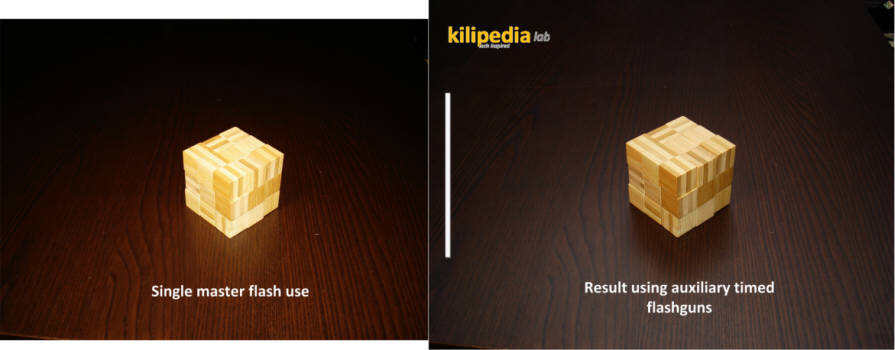

Flash Follower.
Built to enlight the case!
This project is touching a small part of this enormous science of photography.
When i started this project i realized my ignorance about quality picturing. And guess what. I got so much from this project that i can only estimate how enormous photography is. I could learn for a lifetime but it stops somewere here... maybe. For now ill leave it to the professionals.
Project overview
So my approach is about light in a picture which is extremely important when it comes to picture quality.
In this project I have built a set of auxiliary flashgun triggers that improve picture quality by triggering simultaneously when my, on camera flash, goes on.
In other simple words when i push the button of my old ordinary digital camera and the on board flash goes on, my controller detects the light change in the room and instantly triggers the auxilary flashguns which are surrounding the object of interest.

shooting topology

the prototype controller

auxilary flashguns
The software

Intrested in more info? contact me here


Thank you for your interest in innovative research
Kilimpas V.

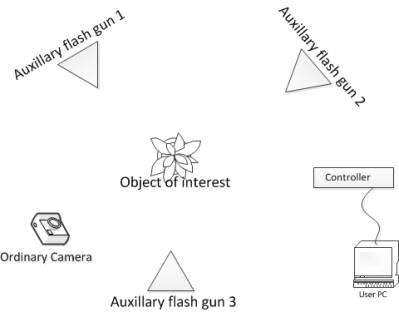
A draft topology is shown in the chart above.
Well that's not new for photographers as this system already exists in the pro's market for years now.
My approach is about timing. And that's becauce the problem IS about timing. Many of the cameras on the market produse several flashes before the actual shooting flash in order to correct other picture issues which can trigger conventional auxiliary flashers immaturely.
This prototype is giving the photographer the ability to adjust the trigger time right on the actual shooting time. It can also be used with a smart phone!
The prototype controller has the ability to trigger each one of the three auxiliary flash guns individually right after an adjustable certain time period after the "master" on board flash changes the room light level.An of course we are talking about milliseconds.
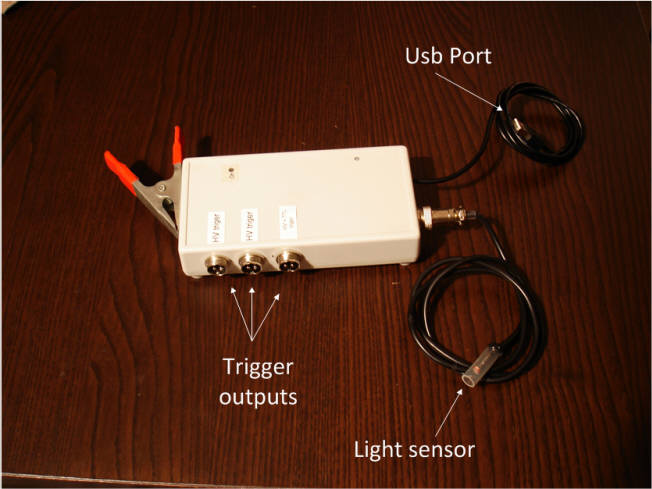
In the picture above is the prototype controller which is usb powered.
There is an output port for each flashgun. There are two outputs that can handle "high voltage" triggered flash guns and one output that can handle both "high voltage" and "ttl" (more modern) triggered flashguns.
The light sensor is the sensing element that helps the controller to collect light level data from the studio.
In the picture below are the three flashguns i use for auxilary devices
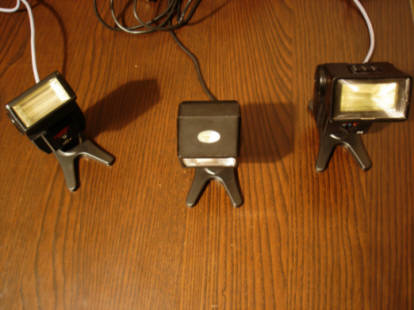
My favorite.
This windows program is the configuration application for the controller in order to syncronise the three flashguns with the master flashgun.
application screenshot (click to enlarge)

The result.